Continuing my occasional series on urban planning, I’d like to turn my attention to the topic shopping center planning.
Charlottesville is currently ramping up an enormous glut of shopping centers. We’re soon to have just over fifty square feet of retail space for every Charlottesville/Albemarle resident, if memory serves. This will inevitably result in the inner sections of our suburban ring being abandoned. Albemarle Shopping Center will be the first to go. Barracks Road Shopping Center may well last, thanks to UVa students, but they’re bound to decline. The really ridiculous part of adding these things is the argument made by the developers, who say that the shopping center will contribute X million dollars to the public coffers each year. That’s foolish, of course — adding new stores doesn’t increase spending. We’ll just spend our money there rather than elsewhere. For the county it’s a wash.
Our latest shopping center is Hollymead Town Center, named despite the lack of any town named Hollymead and that it’s not in the center of anything. (This is only slightly preferable to the habit of naming shopping centers after the natural feature that has been eliminated to create it. Shady Pines. Lakeview. River’s Bluff.) Constructing it involved leveling dozens of acres next to Route 29, just north of town, turning an enormous area immediately next to the airport into a muddy pit. Plans call for a commercial area up front, with housing farther back from the road. I eagerly await the new residents’ complaints to the county about the jet noise, which rank right up there with developments adjacent to farmland that yield complaints about the odor of animal feces.
The purpose of all of that dirt-moving was to create an enormous bluff, on which the shopping center perches. Not willing to settle for merely raising the whole affair ten feet into the air, they put an oversized parking lot between the highway and the buildings. From the road, it looks a little like this.
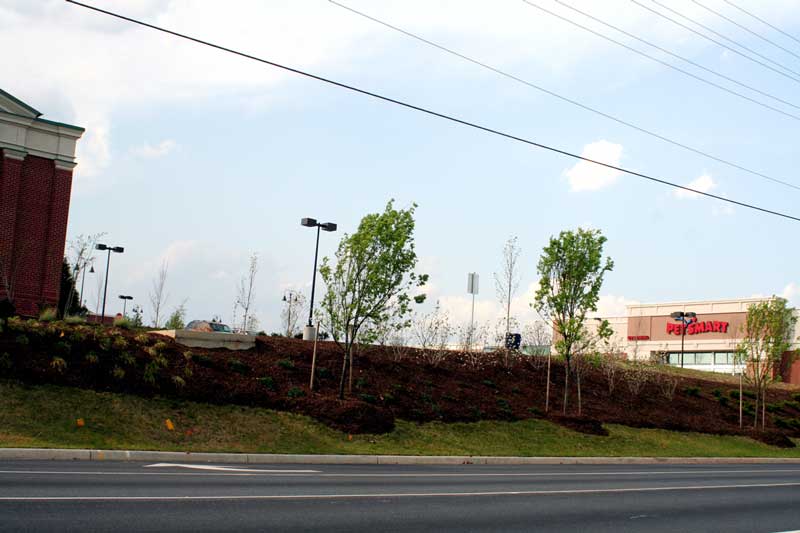
Can you tell what’s in that shopping center? If you have good eyes, and you’re familiar with the logo, you’ll see a Petsmart. On the left, just cut off, is a bank. That’s it — only two shops.
In fact, there are dozens of stores up there. An entire Harris Teeter. A Starbucks. A couple of restaurants. A video store. Even a ginormous Target. You’d never know it. Apparently this is problematic enough that Target decided to pony up some money to let people know they’re there.
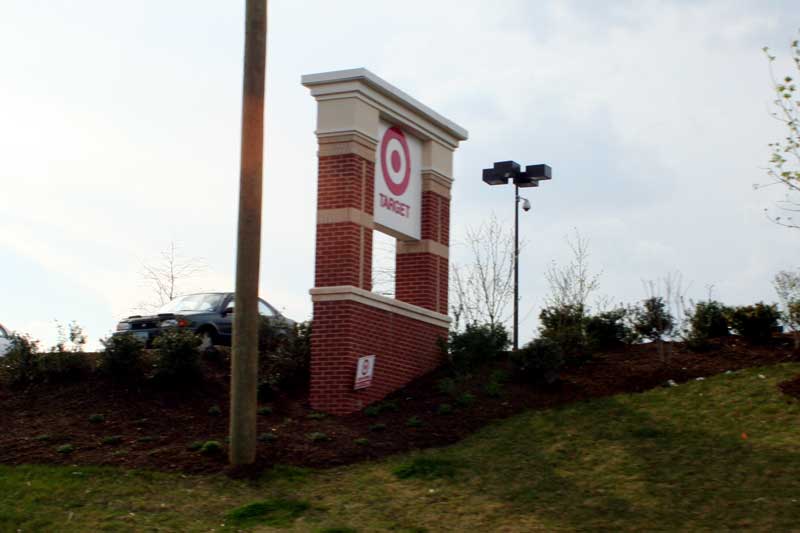
Hollymead Town Center has done two things wrong here.
- In an effort to make their shopping center more visible and seem more important (anticipating their nearby planned competitors), they’ve physically elevated it. The road runs immediately next to the hill, though, so its elevation serves to hide it, the precise opposite of their presumed intention.
- Presumably out of sheer habit, the developers placed the parking lot in front of the stores, rather than behind them. This places so much distance between the road and the storefronts that it is simply impossible to see the buildings, to say nothing of the signs or the contents of the store’s windows.
Elevating the shopping center is bizarre, but the parking lot setback is standard. And it’s a standard that should have been ditched years ago.
Remember window displays? Those are gone. There’s no point. With acres of parking lot separating roads from shops, people have no opportunity to be enticed by products.
A central tenet of proper urban planning is the concept of enclosure. There’s a proper ratio of building height to road width to make people feel as if they are securely part of a streetscape. That’s part of why people love Charlottesville’s Downtown Mall. When buildings are set back so far on either side of the road, there’s no streetscape of speak of. There’s no enclosure. And so we feel no sense of belonging or connection to our environment when we occupy it. That’s anomie in action.
The solution? Municipal planning guidelines should be modified to encourage — or better yet, require — such developments to conform with some basic streetscape standards. Move parking lots around back, or distribute them around all sides. Set buildings close to the road. And keep such shopping centers close together, rather than set apart. When they try to stand alone they opt out of the community, which impacts our transportation infrastructure, our collective concept of place, and our sense of community.
These simple changes would be good for customers, good for citizens, and good for business.
Albemarle Square looked like it was gone last year. Except for the string of shops at the far end near the theater, there are less than a handfull along what used to be the main strip. And frankly I don’t think ACAC helped anything by turning their main entrance away from the Square and toward the theater, making what was once overflow parking their main lot.
In addition to the empty shops, there’s the abandoned restaurant up near the bank, and another one that’s only opened after 4pm. Everytime I’ve been in the Circuit City, it’s like a Ghost town and their employees look like they’d rather be anywhere else (although this I am told is at least in part due to the elimination of commissioned salespeople at that company).
Growing up here in Cville, the conventional wisdom as I’ve always heard it was that the town has more restaurants than one this size should reasonably be able to support. I guess now that will also be true for retail space.
One reason that developers put the parking out front is to assure you that parking, indeed, exists. The earliest shopping centers consigned parking to to courts behind the buildings. That worked well when a substantial part of the customer base took public transportation or walked to the stores. Also, cars in the parking lot let one know that the center is open and popular. (“See? There’s cars there! It’s safe and fun!”) Or, not, as in the case of dead malls. And, Albemarle Square.
When I was serving on a County of Albemarle committee engaged in rewriting zoning laws, I argued for the inversion of the usual code provisions, which demand a certain minimum number of parking spaces for ever 1000 square feet of retail floor area. You want a bigger shopping center, you add more parking. The ratios are sized for the Friday after Thanksgiving, so much of the lot is seldom used. I wanted a maximum number of spaces per 1000 square feet, so that the parking lot size is minimized. This suggestion was watered down, but accepted, I think. In retrospect, it wasn’t enough of a change.
Part of the “bluff” business is that parking lots can’t be too steep, or car doors won’t close without real effort, shopping carts start zipping around on their own, and some other annoyances appear, including interesting stormwater issues. This is another reason why parking areas are to be minimized.
Very interesting, Brian.
Are we really going to have that much of a problem with empty shopping centers when these shopping centers are all bringing in new residents of their own? I can see places like Albemarle Square and Shopper’s World biting the dust, but there is a lot of retail that isn’t here yet, along with thousands of new residents, so I think that will at least minimize the problem.
I have this pipe dream that the County will purchase derelict shopping centers and turn them into parks, green space, etc.
Dan,
I’m having trouble thinking of a single instance, anywhere, ever, in which a shopping center was bulldozed to put in some new trees. That’s why you’ve got to be real careful about what you put where. Once that field or forest is gone, it ain’t coming back any time in the next thousand years or so.
If the City of Charlottesville didn’t block every new road project (29 bypass, Meadowcreek Pkwy), then residents in the urban ring might actually make an effort to get downtown to shop. As it is, shopping in C’ville is a pain in the neck for anyone who isn’t already there. Traffic on Rio and the 250 Bypass is ridiculous, and parking is a huge headache everywhere except for the stores on 5th Street, with Barracks being only slightly better than Downtown or the Corner.
The population of Greene County is booming, and those people drive to northern Albermarle to shop. Building shopping centers isn’t cheap, and those who do so have extensive market studies to justify the expense. I have a feeling that the new development around Forest Lakes will do quite well. And something will fill in the gaps at Albemarle Square.
A central tenet of proper urban planning is the concept of enclosure.
This a really good point, and the two relatively new shopping centers in Richmond (both opened in Fall 2003) are good examples — Short Pump Town Center and Stony Point, two enclosed outdoor malls that are manufactured attempts to create an atmosphere like C’ville’s Downtown Mall. They can’t artificially create that, of course, since much of what makes the Downtown Mall what it is consists of the mixed use — offices, unique stores, residential, etc… but still, those wannabe Downtown Malls are a far cry better than strip mall hell.
Maybe in a few years, when their trees get a lot bigger, it will feel a little more like the real thing… but I doubt it.
Actually, the County opposed the 29 Bypass, at the behest of environmentalists who were concerned that no study had been made of the threat to the reservoir, western urban-ring residents were were concerned that their neighborhoods were to be destroyed, and of the general citizenry who were appalled at the extraordinary expense of building a by pass that wouldn’t really pass by much, dumping traffic into the area now congested by the likes of Hollymead Town Center. And, the proposal to build grade-separated interchanges at Hydraulic hasn’t been followed through by VDOT, either, and that was a prerequisite. All in all, the western bypass looks like a lot of money–what was it, $270 million three years ago?–very well not spent. Better plans seem to be to establish roads parallel to Route 29.
The Meadowcreek Parkway is a city thing, but there’s no certainty at all that it would be to Charlottesville’s benefit to build it. At this point, I don’t know that it would relieve Park Street of much traffic for very long.
You know something, I really don’t care anymore…bout all the growth in Albemarle Co. Always been too many Yankee liberals. I used to care about growth (back when I thought it was possible to stop em…somehow.) but anymore, I just look at the value of real estate, and how my family is set to do pretty darn well after having scrapped by for years and years. We worked the land where I grew up, off of Proffit Rd when I was a kid. After school, we were worked in a way unfamiliar to most of the rich kids who I went to school with. When we were’t working, my brother and I went to 4-H, fished down at a neighbor’s place or explored the woods. Yes, things were simple in that part of Albemarle just a quarter century ago.
But you’re right Waldo. Now there’s a big shopping center up Proffit a couple miles replete with the Starbucks. Never needed Target or Harris Teeter when I was a kid; we always did our shoppin at “Maupins Grocery” the little 8 short aisle store that if you look behind the BB&T bank, you can still see (Of course, Kenny Maupin has moved on too.) Used to be a whole lot less cars on Proffit too. Dad and I used to jog to Mr. Miller’s (the little white house at the hairpin curve bout a mile down Proffit) and back for exercise and never had to worry bout being run over. Hard to believe, but true. Thank God that one lane wooden bridge is still there though. It does my heart good to know how pissed it makes that commuters who use Proffit as a short cut. Screw’em.
Guess I shoulda known it would change. Silly to think I could stop it. And frankly, not very “freedom loving” of me, to want to stop it.
My ancestor Michael Woods settled Albemarle County, in the 1730’s (before it was Albemarle) and is buried there at the foot of Woods Gap, more commonly referred to as JARMAN’S GAP. That was almost three hundred years ago. He moved West in search of a better life for himself, and his family. It’s gett’in close for me to do the same.
As a matter of fact…er…it’s not. Sorry, Ben. They closed it down about a month ago. You know how when you drive over it, those wooden boards would flip up in the air behind you and clatter down? Turns out that’s not just endearing, but actually not so safe. So VDOT has closed down Proffit at at the bridge, diverting traffic down Polo Grounds (kind of — their horrible alternate route is a blog entry unto itself) through the tunnel under the railroad bridge.
The good news is that they intend to put in a similar bridge as the replacement — still one lane. I’m convinced that it’s that bridge and the railroad that will save the Forest Lakes beast from growing too far down Proffit and towards Stony Point. One lane roads aren’t conductive to development. It’ll be decades before that bridge is replaced, and it may never be viable to replace or expand that railroad tunnel. Here’s hoping it stays that way.
I Publius,
You kidding me? Downtown is constantly packed. Business is booming. I’ve been working and playing on the Downtown Mall for about 14 years now and I know what I’m talking about. Plenty of people are coming downtown. The place is lousy with shoppers. In fact, it’s gotten to where I find myself bitching regularly about how there are just too many people here.
There are all kinds of things you can get into about why we should or shouldn’t build various new ideas for roads. But the economic health of downtown is not among them.
You know, last time I was home a couple weeks back, I saw where it was closed but just figured it was for repairs. I hope they can somehow manage to keep it a wood structure. Do you know if that’s the plan? I assume the thanks for keeping one-lane should go to Fred Gerke and Jared Lowenstien…but that’s just a guess.
I think that’s fantastic. I’d almost support keeping it shut for good, ‘cept fer Gerke would have a helluva a drive to get to work, and the worshipers at Evergreen Church on my side of the bridge would have a haul on Sundays.
They can’t artificially create that, of course, since much of what makes the Downtown Mall what it is consists of the mixed use — offices, unique stores, residential, etc… but still, those wannabe Downtown Malls are a far cry better than strip mall hell.
These things have a name: Lifestyle centers. I suspect Patrick McGoohan coined it. In any case, some things the like of which you will not find in a “lifestyle center” are:
Dancing Man, who used to haunt Central Place every noon, bouncing on a trampoline to a walkman for 45 minutes or so, clad in running shoes and gym shorts.
The late and much-missed Phil Gair, whom I knew for twenty years without ever knowing his last name.
Tables set up by LaRouchies and packed with literature exhorting us too-complacent Virginians to take up arms against the true-life Kayser Soze of our times: HRH Queen Elizabeth II.
Or, basically, anyone who acts as if life were more than a shopping opportunity. That’s what makes the Downtown Mall special, its publicity. And it’s a real shame people don’t sense the privation of these lifestyle centers and malls enough to to flee the moment they step into one. Or, flee the moment they secure the pecan-rolled cheddar log that lured them to Hickory Farms in the first place. And why it’s important that owning a car not be prerequisite to experience the Downtown Mall.
That old railroad cut bridge is there to stay. It’s part of the Proffit historic district, and you know how we feel about our historic districts ’round here. Proffit was a town started by former slaves, and included a general store and a post office (now a derelict stone building with broken windows.) I don’t think that section of Proffit Road can ever be widened.
Good post and discussion thanks.
Harking back to the first point Waldo made (re: the enormous glut of shopping centers), for what its worth you’re not the only ones overbuilt on retail. Early this week a Northern Virginia developer was complaining to me about just this issue as a problem in much of the state.
I couldn’t agree more—I find little more satisfying in blogging than finding a discussion to be so much more educational than my original post.
Sounds like some of the planners and engineers from Hampton Virginia have been helping. The Planners and engineers have really created a mess of things here in Hampton…our two departments need to be cleaned out from top to bottom. Thier plate is full of projects that citizens are up in arms over…Council has thier plate full and may have to deal soon with Ft Monroe, the 500 acre waterfront historic military base being turned over to VA or to Hampton(?) as the Brack Commission is closing the base soon….
Jack…
Downtown is usually packed, and that’s a great thing. But don’t kid yourself that a week’s revenue there even compares with one Saturday at Wal*Mart (unfortunately). Most people on the mall browse and enjoy the atmosphere. It’s not a place many people go when they’re buying groceries or a stereo or books, or a computer or even clothing, for that matter. It’s nearly all niche retail.
I worked on the mall from ’85-2002 — and its transformation was remarkable and wonderful. Twenty years ago, the mall was a ghost town from November to April, and you NEVER walked alone at night regardless of the time of year. But it’s much different now. It’s the one thing I miss most about C’ville.
Overall, however, retail in C’ville is not particularly strong, mostly due to the big stores in the county. A few years ago, the city had a chance to get a shopping center like the new one near the airport, but the political pressure from downtown retailers killed it. They didn’t want the competition. Problem is, those types of stores don’t compete with shops on the mall. If anything, it would’ve added to downtown business, since people would be coming to C’ville to shop (or, rather, not going to Albemarle).
Oh… and the (recent?) change of charging admission to Fridays After Five… that blows. I spoke to Tony LaBua about that a while back, and he tried to defend it, saying that the revenue was needed. The choice was between raising the beer price versus charging admission. As one who usually has a beer or three at Fridays, I’d gladly spend more money overall by paying a dollar extra for a beer than pay any admission. Having it free has been a big part of the “spirit” of the event since its inception — that anyone could just mosey on up and enjoy it. I hope they’ll reconsider the policy.
You’re a few years behind there. :) I was on the CDF board shortly before the decision to start charging, so I saw what led up to it. First and foremost, corporate sponsorships completely dried up immediately after September 11th. Second, the city decided to start charging rent for use of the amphitheater, and price tag was enormous. (Why they’d charge rent to a civic non-profit who played a huge role in revitalizing downtown, I genuinely can’t imagine.) Thirdly were a number of small factors that conspired to require more income to cover the changing lineup and style, which were discussed ad nauseum on cvillenews.com in 2003. But the result just didn’t work, so they reverted to making it free just a year later, deciding to feature local acts rather than national acts that nobody really cares about.
But the amphitheater was turned over to Coran Capshaw just a few weeks later. CDF ran FAF through the 2004 season, at the end of which Coran agreed to have free concerts every Friday during the summer. CDF closed up shop, no longer having a venue for FAF and thus, the cash cow that allowed them to exist was gone.
So, yes, FAF is free.
Back to the original thought–It’s distressing that Hollymead has turned out to be so poorly put together. I know we’re still in the early phases of it, but it sure ain’t the lovely complex-of-the-future entity we were promised. Just kind of an ugly shopping center with a Target. Ho hum.
I actually stopped by that plaza in May to visit a friend at the Panera. Nice looking plaza, due to the fact it was so new but I could not believe how hard it was to see and access. It also seemed very far out from Charlottesville. I agree, they could have done a better job with the design.
I’ve been to the Hollymead Shopping Center once and it was a strangely unsettling experience. I was in both the Target and the Harris Teeter and it felt oddly alienating. I don’t know if it was the size of the stores, the lighting, just my unfamiliarity with the layouts, or what. Somehow, even though I was just a few miles north of Charlottesville, I felt as though I was in New Jersey. How could this be?
I didn’t see anybody that I knew or had ever seen before. There were no local accents to be heard. Was I in the Twilight Zone?
I haven’t returned.
Chris..it is a pain in the @$$ to access. Dunno who’s at the helm of that one. Saw the signs next to it when I was there last, “Town Homes Starting From the High $280’s (WOW) w….o…..w
Harry, you weren’t in Jersey; NEW JERSEY has moved HERE!
Can someone correct me if I am wrong but weren’t some numbers released that showed that there was a lack of retail in the area? All you have to do is a take a trip down to Short Pump and count how many county stickers see from Cville and surrounding counties to get your own evidence of this. When you think of the Charlottesville retail market you can’t just think of Albemarle and Charlottesville. You must remember that Cville-Albemarle is the economic center for Albemarle, Cville, Nelson, Louisa, Western Orange, Buckingham, Madison, Greene, and to a lesser degree Augusta, Staunton, and Waynesboro. I would much rather have these shopping centers going up in urban/suburban Albemarle than out on a beatiful mountaintop in Nelson County or a rolling field in Madison. The population of the Charlottesville Metro Area has ballooned to close to 190,000. When you add Orange, Louisa, Madison, and Buckingham you get close to 280,000 people. Add Augusta/Waynesboro/Staunton and you are talking about close to 400,000 people. Now look at all of the retail development in the area ask yourself if we are really being that over crowded by retail stores. The anti development groups have been saying for a quite a while that old 29 (South of Rio Mills) will become plagued by empty shopping centers if development continues up the highway but that has not materialized. In fact not only are the centers realatively full but you occasionally see some areas being redevloped to allow for more space. Take Bo Jangles, Etna by the mall, the old Change House, for example. These areas in the old 29 area have or will be torn down for a denser development. Economic growth is a good thing and these new developments bring new jobs and make the market more competitive for employees seeking pay.
I do not support all untrained growth but I do think getting upset over a development like Hollymead Town Center on a major corridor is a bit absurd. The development is only 7 or 8 milles from town and surrounded by thousands of residences. While it is important to stress dense development and what we consider efficient land use we must remember the real world. Not everyone wants to pay to park their car, not everyone wants to walk up and down a brick mall, sometimes people want products for a cheaper price than you would find at a mom and pop store, people like name brands, people like outlet centers, not everyone wants to live in an apartment over a bakery, some people want yeards, some want a moutain view, some want to live in the country, others in the suburbs etc. These people should not be vilified for their preference and the developers should not be vilified for their effort adhere to these preferences. There are some real greedy and dirty corporate crooks out there. I just dont think the developers of Holymead Town Center or North Pointe fit that description.
People tossed around that as a concept, but the only numbers I’ve ever seen demonstrated quite the opposite.
I wish I had majored in urban planning so I would know everything that is good for citizens.
As I was walking on 4th and Market I had a couple ask me how to get to the downtown mall. On 4th and Water a group of six asked me how to get to the amphitheater. Clearly our ratio of building height to road width is making the downtown a great place…at least for smokers.
What about looking at the ratio of cigarette disposal cans to bike racks. Perhaps dealing with that issue would be good for citizens. Get your damn paws of me, you stinkin C-Villians!” (I’m sure at least one developer here in town has said that)
I am curious as to what the retailers’ demographic research says. Just how many credit card-holders equal a critical mass? These bus trips (scroll down to “Nordstrom bus trips“) demonstrate a small number of people need their shopping fix.
What’s amazing is that they’re charging for the trips and that, presumably, people will pay. Any retailer that can get a bus full of customers at their store shouldn’t need the $15/head, but if they can get it, why not?
This would seem to indicate that they’re not getting customers from Charlottesville driving to Short Pump, or else they wouldn’t go to the trouble.
Responding to UVA08- I did recently read that while 3 mil sq. ft. of retail is currently slated for development in the C-ville area, 1 mil. additional sq. ft. would bring the area to a point of oversaturation. I also am curious as to where the population figures come from; the closest I can find is the the area has about 160,000 residents (including UVa). While some have the impression that people are drawn to C-ville as a shopping mecca, they have failed to notice that Harrisonburg, Waynesboro, Culpeper, and other areas that might be included in the 400,000 population figure are also experiencing some dramatic growth in retail development.
tar… population figures come from quickfacts.census.gov ….. I didnt mean to imply that every single person from those counties shop in the area but it was meant to show what the general area looks like. In any case if you add Albemarle and Charlottesville you get around 130,000 alone. Then add Fluvanna, Nelson, and Greene(Metro area counties) you get around 190,000. The addition of Louisa, Orange, Buckingham, and Madison takes you up around 280,000 and adding Augusta and comp. takes you up around 400,000. Unless my math is off that’s how I came up with the numbers. The site is quickfacts.census.gov.
Waldo I wanted to ask you what are some good ways to determine how strong a retail market is? The only real hard numbers I can find are total retail sales and retail sales per capita.
Then you’re way ahead of me. :) The only way I’ve ever gathered information about that is by relying on reporters to do the legwork for me. :)
I don’t know how involved you get with zoning boards, commissioners, city councils, sign ordinances, building permits/regulations, and the like but my experience tells me all you see in the photos was dictated by some local government administrator. I once had the good fortune (for about a year) of sitting on the phone, day after day, reading statutes with bureaucrats who enforce rules set by town/city elected leadership and working through a myriad of issues the breadth of which would make you toss your lunch.
Upscale communities are particularly notorious for detailed and comprehensive restrictions – like not allowing pylon signage at entrances to shopping centers, allowing only a certain square footage of signage on buildings (that must conform often to size, shape, color, lighting, etc. requirements), requiring a certain number of a certain species of tree along road frontage (to block the view of passersby), and on and on.
I once worked for one of America’s richest men. He wanted a sign on the front of one of the buildings that housed a number of his offices (he leased his space). The building was in the city where he resides (most of the time) and pays bookoo taxes. I couldn’t get approval for a sign because the building was allowed only so many square feet of facade signage and the other tenants had used up the allotment. The old man, figuring he had some juice in town, went with me to appeal the ruling. He was turned down. My guess is there is no sign letting people know his offices are there to this day – unless someone vacated (then the fight would begin between tenants no doubt).
It’s madness. Shere madness.