When I buy organic, I feel good about it. Heck, I feel good about myself. Because I’m getting, say, beef raised by a local farmer who fed his happy herd of cattle on grass. Some of them may well have been named. These cattle were probably slaughtered in a humane fashion, butchered and packed on site, loaded into the farmer’s refrigerated truck and driven into town, where I bought it at C’ville Market a few days later. My money stays in Virginia, a family farm can sustain itself, and I get a great steak for dinner.
That’s how I once thought it worked, anyhow.
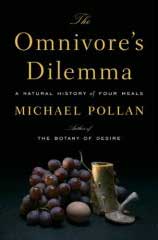 Now that I’ve read Michael Pollan’s “The Omnivore’s Dilemma,” it pains me to admit that I thought so simplistically about something so essential as the food that I put in my body. The truth, of course, is far uglier.
Were this a decade or two ago, my assumed scenario may well have been true. But with the explosion of demand for organic meat and produce, factory farms have modified their processes to fit those demands. The enormous midwestern feedlots on which cattle are fattened up are now divided up between those cattle who eat pesticide-drenched corn and those who eat organic corn. And that’s pretty much the difference between most organic and non-organic beef.
Cows, of course, are not meant to eat corn. They’re ruminants; their fundamental body design has evolved to consume grasses. Cows are no more meant to eat corn than you and I are meant to eat grass. The corn that they eat makes them quite sick, which is why they have to be pumped full of antibiotics. This doesn’t make them well, but it keeps them from getting so sick that they’d stop growing. We feed cows corn because we grow such an unbelievably huge quantity of it, thanks to ill-planned government farming subsides, so we’ve got to do something with it.
So we grow lots and lots of corn in one place, we ship it all to another place where we feed it to cattle, which we ship to another place to butcher, and then ship to another place to be sold, which we then buy and take home. The entire process places a tremendous demand on our transportation infrastructure, requires a huge amount of fuel, and produces beef that is full of antibiotics, steroids and hormones, and is metaphorically dripping with petrochemicals. This is industrial farming.
Once upon a time, “organic” was an indicator. Yes, it meant what it does now, but it was freighted with so much more, all of those assumptions that led to my misunderstanding of the origins of my organic beef. But once the federal government established an organic standard (setting the bar pretty low) and demand increased at a rate greater than could be accommodated by family farmers, it was inevitable that factory farms would fill that gap.
With this understanding, I’ve decided that I really just don’t care about organic. If I have a choice between organic beef from Argentina or regular ol’ beef from Montair Farms, here in Albemarle County, I’m not going to hesitate to choose the latter.
First and foremost, I want to keep my money local. If my money goes to Argentina, I’m never going to get it back; if it stays in Albemarle, I’ll see it again in a dozen different forms over the years.
Second, I want to avoid the pollution and foreign-oil dependency that comes of unnecessarily shipping food hundreds or thousands of miles. Pollan writes about this in “The Omnivore’s Dilemma”:
A one-pound box of prewashed lettuce contains 80 calories of food energy. According to Cornell ecologist David Pimental, growing, chilling, washing, packaging, and transporting that box of organic salad to a plate on the East Coast takes more than 4,600 calories of fossil fuel energy, or 57 calories of fossil fuel energy for every calorie of food. (These figures would be about 4 percent higher if the salad were grown conventionally.)
I simply can’t find an excuse sufficient to contribute to that sort of waste of fuel. I’d like to know how the ratio of gallons of oil from Iraq to deaths of American troops; how many California salads equal a dead soldier?
The third reason and final reason that I prefer the local meat is that I can visit Montair. I can walk right on up, get myself a tour, and buy the meat from their farm shop. It’s not possible to visit many factory farms; good luck ever getting a tour of an abattoir.
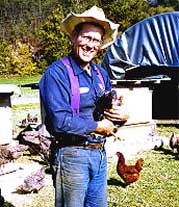 I would be remiss in failing to acknowledge the Virginia connection to “The Omnivore’s Dilemma.” Pollan spends a good bit of his book writing about Joel Salatin’s Polyface Farm, over in Swoope, in the valley. The author holds up Polyface as the ideal of sustainable family farming, and for good cause that is worth relating in brief.
The industrial process farming that I outlined above — corn grown one place, cows in another, slaughterhouse in yet another, stores in another — is incredibly wasteful. The soil where the corn is grown is left ruined. The land under and around the cows is likewise ruined. Every step contains inefficiencies, often hugely wasteful, some of which are hidden in the costs of our transportation infrastructure or maintaining access to oil in the Middle East.
Polyface is the opposite. Salatin’s process is simple. First and foremost, understand that he describes himself as a grass farmer. The fact that he sells chicken and beef and eggs and rabbits is incidental — his primary job is raising grass, delivered to you via a cow or a chicken. He’s got 550 acres: 450 forested and 100 as pasture.
The pasture is set up on a simple rotation scheme. The cows are fenced off with a portable electric fence, and they’re moved around the farm every few days. Three days after the cows are moved, the chickens are brought in with their own portable hutches (known as the Eggmobile). That’s just long enough that flies have laid their eggs in the cow manure and the eggs have hatched into larvae. And chickens love fly larvae. They break up and scatter the manure — accelerating its transformation into fertilizer — get a lot of good protein (one third of the chickens’ diet), and help keep the cows free of bothersome flies. By moving the Eggmobile around regularly throughout the year, all of the pastures get plenty of nitrogen. All of this is made possible by the cows having first eaten the grass, since chickens don’t deal well with grass over 6″ in height.
The forested land cools the air in the adjoining pasture, making the animals less stressed in summer. The pigs are moved about in the forest, via a portable paddock, so they can root around and improve the soil, inducing it to convert to grassland that’s the pig’s natural habitat. The trees slow the winds, reducing the evaporation in the fields and letting the grass use less calories to try and stand upright. Most birds won’t venture into open grassland, but they’ll hang out along the edge of the forest, eating insects that would otherwise bother the animals. The forest allows critters like voles and chipmunks to live there, giving coyotes and weasels something to eat other than the chickens. And the trees are harvested for woodchips that go into the compost — compost that nourishes the grass and, thus, the beef.
The cows eat the grass and poop. Chickens can then navigate the grass, eat the larvae in the feces, and fertilize the fields with their own waste and by spreading the cows’ waste. Which grows grass. Which the cows eat and poop out. Repeat. The end result is that Salatin saves a fortune on fertilizer, chicken feed, antibiotics (to deal with fly-borne diseases), grass-mowing, and so on. The result is that his eggs are $0.25/dozen less than they’d otherwise need to be.
The amazing thing is that, as the years go by, Polyface’s soil doesn’t get worse. It gets better. It seems that we can take from the land without diminishing it. Salatin’s not doing anything special — he’s just farming the way that people have for centuries.
Last Thursday evening found me, my wife and my father in the crowded cafeteria of Western Albemarle High School. (Where I believe I ate lunch once in my two-year career at WAHS. Hallways and the lawn in front of the school were more my style.) The Virginia Independent Consumers and Farmers Association was holding “Farm Food Voices 2006: Local Pastured Meats: Making the right choice for health, taste and bio-security,” and apparently hundreds of people had gotten the memo. A pair of long tables had been set up, stocked heartily by dozens of independent farmers from across the state — a half dozen types of meat and every fruit and vegetable that could be grown in Virginia had been combined into a hundred different dishes, free for the taking. Everything was, of course, delicious — save for the mysterious pie that looked like chocolate with whipped cream but tasted like something closer to ass. Long-haired hippies mingled with guys in suits. A quarter of the audience was either Mennonite or had really bad fashion sense. Both Al Weed and a representative from Virgil Goode’s office were present, along with two candidates for state senate. Honestly, I’d expected three dozen people, half farmers and half aging hippies — certainly nothing like this.
Polyface’s Joel Salatin was the MC, charged with introducing the series of speakers and keeping the event running smoothly. Salatin is a curious cross between a geek, a farmer, and a conspiracy nut, making for a guy that has got to provide great conversation. In khakis, a checked shirt and a blue blazer, he looked more like an accountant than a farmer. But it was also clear, as he talked, that he knew an enormous amount about food. I’d write “farming,” but that’s not accurate. His farming is premised on his understanding of ecological processes and the human body’s process of digesting and extracting nutrition from food. While I can’t imagine there are a lot of farmers like that, there sure seemed to be a lot in that cafeteria.
It has been lamented that farming is a profession that kids get pushed into if they don’t perform academically, or if their families don’t have the option of sending them to college. I got to know a good number of kids at Virginia Tech who were taking over the family farm when they got home, and I think it’s fair to say that it was a distinctly average bunch. Certainly not dumb kids — just regular. They had gone to VT to learn pest management, animal husbandry, crop maintenance, etc. What they did not learn about, and were not required to learn about, was nutrition or ecology. We’re teaching our children how to run tiny factory farms, to be reliant on Roundup Ready seeds, to ignore the wisdom of millennia of farming for the innovations of the past fifty years. This may well serve them well, but I wonder whether there will be anything left of their farm to pass onto their children in twenty five years.
Talking to people in WAHS’ cafeteria made me feel better about the future of Virginia farming. Hundreds of people came to learn more about how to raise chickens without being reduced to being a chicken janitor, how to raise beef without sickening the cattle, how to farm so that the land is improved by the process, not diminished. I never would have guessed that there was such broad interest in that ideal among consumers and farmers alike.
 I’ve changed my view on organic in the couple of weeks since I’ve finished reading “The Omnivore’s Dilemma.” That’s just one small way that food can be better for me, for the environment, for the country and for the world. And I think the merits of organic pale next to the merits of sustainable, local family farming. I want organic food for the same reason that I want nutritious food, but I see now that organic is just one small piece of a much larger picture. Joining a CSA program and maintaining a sizable home garden are two steps steps that I’ve taken towards eating better and having a healthier environment. And when I purchase meats and vegetables, I try to not just buy American, but buy as locally as possible. The means no tomatoes in January or apples in April, but instead hewing more closely to the seasons.
“Organic” is no longer the watchword that it once was; you cannot assume that it represents more than it does. Start paying attention to your foods — find out what country or state they’re from. (Hint: If it’s from Whole Foods, it’s probably from a factory farm.) See if you can get a sense of how big of an operation produced it. Try and buy foods from farmer friends in your area. Not only will you be more aware of what you’re eating — something much more fundamental to your well-being than, say, what the Virginia General Assembly did today — but you’ll probably find that your food is a whole lot tastier.
Good stuff.
Interesting read. Thanks.
Good article, Waldo. I would add something. Virginia allows and requires the spreading of human waste sludge (biosolids) on farms, where it then enters the food stream again. Del. Abbitt had an interesting solution to curb it somewhat. His bill requires that only the product of the county can be spread in that county, nowhere else.
Local farmers are put in the position of accepting this waste product because it is supposedly cheaper than nitrogen and other petrochemical fertilizers.
This sludge, if not from the county where it is spread, will wind up somewhere. Watkins’ bill also required that the spreading of biosolids in these other locations outside the processing counties would stop on January 1, 2007 and required the DEQ and VDH, among others, to finally analyze this compund and determine once and for all if it is harmful to humans.
I do know one thing: the Willis River, near me in Cumberland County, is on the Commonwealth’s polluted river list, and the prime pollutant is human colliform bacteria.
Someone please correct me if I am incorrect about Abbitt’s bill in 2006.
For more pollution and environmental justice information, please see Scorecard
Mark,
Virginia REQUIRES the spreading of human waste sludge on farms? That can’t be right, can it? Why would they require a farmer to use human fecal matter to fertilize their crops? Can you provide more detail?
I am sure you all have seen Supersize Me. If not, rent it. I also am sure you have read fast Food Nation by Eric Schlosser. If not read it.
Maybe ‘requires’ is the wrong word.
The Virginia Supreme Court ruled in 2001 that counties cannot ban the use of biosolids. I am still looking for the cite. The ruling was cited in the 2003 case in Appomattox County in which the county wanted to enact certain ordinances to regulate the spreading of biosolids. The judge ruled in 2003 that the ordinances constituted a ban:
Around 40 counties currently have biosolids being spread on their lands. Big money interests in several associations all opposed efforts to ensure the safety, if any, of these materials that are being spread on farmlands around the state. Evidently, the cities want us in rural areas to spread this sludge on the fields used to grow crops or graze animals. It is being expressed as being a situation of having too much waste in cities and not having enough in the country.
Representatives from the Virginia Association of Municipal Wastewater Agencies, Virginia Municipal League, Virginia Agribusiness Council, Virginia Forestry Association, Virginia Forest Products Association all spoke against the bills. A lawyer representing the waste haulers Synagro and Recyc Systems also spoke against the bills.
So while no one is required to apply this material, there seems to be little to stop someone if they want to, and there are financial incentives to counties for help with alledged monitoring.
I’ll have more later. It is one of the biggest issues I work on in this county.
I’ve never really understood the objection to poor treatment of food-cattle. If there were any moral/ethical concerns involved, I’d think it would have something to do with the fact that their throats are slit allowing them to bleed to death — not that they get an inappropriate diet. The latter kinda pales in comparison to the former.
If you’re ok with killing and eating them, the rest is just effluvia. At least, insofar as it applies to animals.
Thanks Waldo. Another great story. Any ideas how to locate grocery stores that sell local products? Here in the suburbs of Richmond, I only know about a Ukrops down the street…
I just don’t eat beef anymore, not after working for a campaign in South Dakota and learning just a little bit about how corporate ranching works. I don’t want to get BSE thanks. I don’t have the energy or time to be so vigilant as to make sure my meat comes from a healthy source. So I avoid it altogether.
Of course I’m probably eating soy that comes from Monsanto in its place; what can you do? without making policing your food a full time job.
Because there’s a direct relationship between how they’re fed and how healthy we are. For example, grass-fed cows don’t get E. coli. (Of course, there are many, many kinds of E. coli — I mean the variant that cows get that, in turn, kills people.) E. coli develops in the rumens of corn-fed cows. No corn, no E. coli. (For that matter, if the cows are simply fed grass for the final week or two of their lives, no E. coli. But feedlots have no grass. It’s not an option.)
To provide another example, corn-fed cows contribute mightily to the degradation of farmland in the midwest, exhausting the soil by planting only corn (and occasional soy), to say nothing of farmers’ reliance on a corn subsidy system that just isn’t working.
On the topic of moral concerns, though, author Michael Pollan spends a good bit of time on the question. He’s denied access to any slaughterhouses, but he spends a time talking with an expert on the topic and learns how they work. Then he participates in a chicken slaughter at Polyface. And finally he kills his own boar, guts it, and eats it (though not all at once :). He reflects on the difference in each of these processes, considering which is more humane, which is “better,” and which he prefers.
I think it’s great that Albemarle is providing a forum for farmers or making space available for them to meet with the consumers who support their operations. Here in Cumberland (where total agriculture and related jobs come second only to the school system), there is not even an agriculture program in the schools any longer. (As a matter of fact, the number of vocational programs in the schools is decreasing each year.) As a former ag teacher, I am very aware of the problems/issues in producing beef for market.
As the need for meat increases (in some cases due to diets that push protein rather than carbs), the problems will increase. For example, one reason they use lights in production chicken houses is to keep the chickens eating for longer periods of time during the day—that way they put on weight much faster. At one time, the poultry companies also were accused of putting chemicals into their feed. The idea was that if the chickens’ didn’t feel good (stomach ache???), they would eat more thinking they were hungry. I much prefer the concept of the Eggmobile (or the “chicken tractor” approach as one of my friends describes using the concept on her place). Wal-Mart has been known to use carbon monoxide in their packaging process to keep meat looking fresher longer, even past it’s expiration date. And that is only one food chain-store; how many others are there that have similar practices?
We also face many of the same problems in producing vegetables. As the need for fruits and vegetables increases (especially with the need for fiber and the fact that many of them can be eaten in “unlimited” amounts on some diets), commercial raising of vegetables is going the same way as beef—using chemcials to make them grown faster, free of pests and at the right stage of maturity for the market. How many times have we heard reports that produce at markets contained traces of pesticides, harmful bacteria, etc.? We grow our own vegetables for our use in-season in 500 sq. ft. of gardens, and can or preserve the rest for use at times when it is winter. One reason I like growing my own is so that I know how they were raised. On the other hand, many CSAs have agreements with their member farms that limit what they can use. If I couldn’t grow my own, I’d want to participate in a program like that.
Great post. I think I can manage to spend a little time paying attention to where my food is from.
Awesome post Waldo, and that book really makes one think about what we stuff into our bodies.
For a few years my wife and I were “share-holding” members of the Bull Run Farm not far from our home. We’d pick up a share of the output of the farm each week (mostly produce, but sometimes honey and meat from a slaughtered farm animal). Our share paid at the beginning of the year helped the farmers buy important seed stock and supplies, and it was a bit of a gamble what we got each week. Some weeks were fabulous, others (the week after the bear struck the farm) were not so good.
All the produce on the farm was documented throughout it’s life cycle on the website, and the folks there are very nice. I recommend similar local solutions if they are available to everyone. The catch is there are a limited number of shares in each farm like this, and it has to be a supplemental source; as we ate more than one share of the output most weeks.
I am considering going mostly vegetarian, not in protest to eating meat, but in protest for all the crap that comes in our meat. Another thing about wheat grains, how many of them are genetically engineered and therefore patented and licensed unnecessarily? I just don’t see any reason to make the executives at Monsanto any richer than they already are.
I don’t know any central resource to locate such stores, but I can tell you some of what to look for. Anything calling itself a “cooperative” or a “coop” is a step in the right direction — those sell local meat and produce. (Annie’s was a great coop just two blocks from me in Blacksburg — if you wanted a fresh chicken, you’d sign up a few days in advance and come pick it up from the farmer, who’d just slaughtered it.)
If their website is any indicator, Richmond’s Good Foods Grocery likely has decent local produce and meats, and they have a few different locations in the area. Ellwood Thompson‘s website makes very clear that they qualify — they name the local farms from which they buy their produce right on the front page of their site.
Perhaps some Richmonders could name some other places scattered about the area?
BTW, great discussion — I’m really enjoying reading these comments.
I’d be a bit skeptical of this book. First, corn is grass. We raised dairy on corn/sileage and hay – they didn’t need antibiotics except in cases where there was a known diagnosible sickness in an individual cow.
The author spends rather a long amount of time explaining how corn evolved to be different than your standard grass — probably the first quarter of the book is dedicated to an exhaustive account of the nutritional properties of corn, how and why it came to differ from smaller grasses. Later in the book he explains how that affects ruminants.
The link between feeding cows corn and the need for antibiotics has been well established — publications from Time Magazine to The Stockman Grass Farmer have written about the causation.
Excellent blog. :)
Waldo — Not having anything original to add to this discussion, I was tempted to join the chorus and add just another “good post”, but I don’t think that is properly in proportion to what you have given us here.
This is not just a post. You’re written an article. You begin with a book review, but then move it into personal observations and experiences. You have provided us with a wealth of information and launched a great discussion. In another age, I would say that this article should be published in a newspaper or magazine, but this “new media” allows a grander level of immediacy and interactivity. This is just damn good writing.
I am seriously concerned about these issues and for the health of my family. Like Joanne, I thought there was little I could do, but you’ve made clear how important it is to be an activist when it comes to what we put in our body. I will share this article with everyone I know. Thank you.
That’s awful kind of you to say, Sean. My goal really is to provide enough information to warrant some engaging, widespread discussion, which is what we’ve seen here so far. I want to learn from y’all, because I know that collectively and individually, you folks are a lot smarter than me. As Jurassic 5 put it, “what you give is what you get.”
Very impressive writing, Waldo, on a fascinating and important topic. Great work.
I’ve never really understood the objection to poor treatment of food-cattle.
You may wish to read the following, which gives the most compelling argument I’ve read on the matter:
http://www.amconmag.com/2005_05_23/cover.html